
I was brought on as the first Technical Narrative Designer in Remedy’s history and among the first in the world.
Remedy’s narrative team had world class elements (world-building, writing, Sam Lake), but tended to be very siloed and divorced from the dev process. The narrative pipeline was also severely lacking and I began consulting on new approaches to narrative tooling and systems immediately after joining.
Now, after 5 years, the tooling is reaching a shippable, (almost) writer-friendly place and the narrative team operates as the locus of projects - not just on a story-level but also for inter-departmental collaboration and content implementation.
Of course, this required several people in key positions, including engine programming, tools UX, and narrative leadership. My role during this change was predominantly system design, tools consulting, implementation and building the department’s reputation for approachability, communication and technical excellence.
I’d love to talk in more detail about anything here, please just get in touch!
Five years ago the quality of the narrative tooling was bordering on farcical, with the writing craft having abandoned it long ago for pastures greener (Final Draft) and with the other crafts trapped into using it despite it’s shortcomings.
Work on NED has been an ongoing responsibility with my being in close contact with the team building it as the primary Narrative Design stakeholder.
At first my role was more theoretical but, since shipping Alan Wake 2 and becoming intimately familiar with Remedy’s tools, workflows and teams, I have been able to provide more concrete designs and feedback. The long, iterative journey NED has been on has been one of the most satisfying of my career; and my focus on UX, useability, production tracking, learnings from other projects, and narrative system design is really starting to bear fruit.
NED is now the tool in which Writers write screenplays, Narrative Designers organise and branch dialogue, Audio Designers handle systemic dialogue and the whole team trusts to be the source of truth for content placement and mission flow.
Narrative Editor (NED)
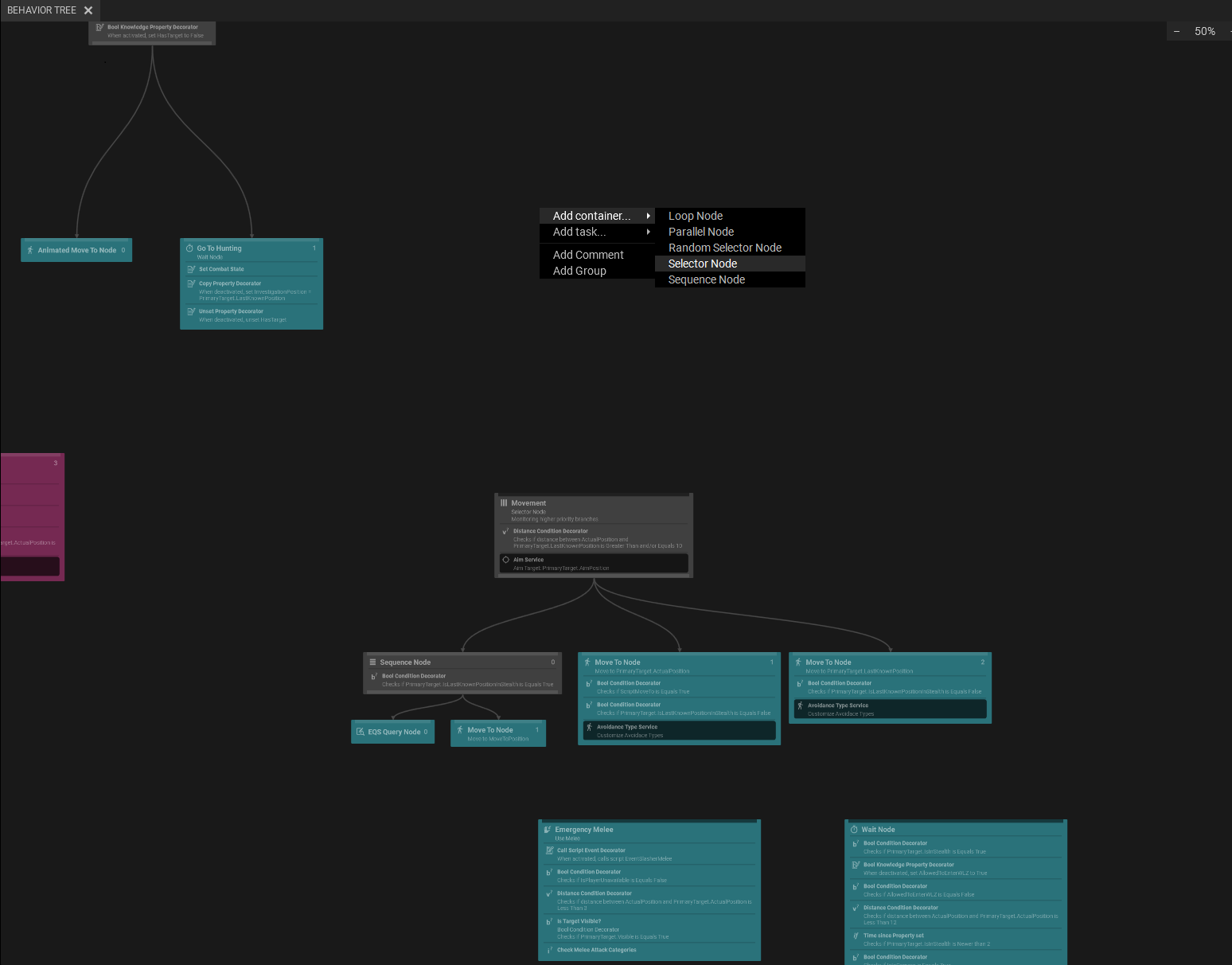
This is not NED, but it is built on the bones of the same node system (this is also the only Remedy node tooling image available online)
Narrative systems
My greatest contributions to the Remedy system milieu have been the Dialogue Queue, the Interruption system and the Narrative Animation Flow.
The Dialogue Queue is a logic layer above NED which handles prioritisation, ordering, relevance, salience and playback of dialogue.
The Interruption system makes transitioning from one dialogue to another as natural as possible by tracking the current speaker, the interrupter and the other participants of a dialogue event. The system uses short inhalations, glottal sounds and slight overlapping with previous dialogue to truly stamp out the overt turn-taking that has always plagued video games.
The Narrative Animation Flow is a long overdue feature which brings previously disparate disciplines in one tool. People needing characters to transition into and out of AI locomotion, player control and canned animations can do so now without technical intervention or bespoke scripting. Before this, every part of this equation was a very distinct system requiring ad-hoc Lua glue to hold it together.